AGENT PAYMENTS PROTOCOL
By Nalba Advisors September 2025
Introduction
AI agents are changing the way we interact in the digital world, evolving at vertiginous speed and becoming actors capable of understanding complicated requests and carrying out entire tasks for us. Hotel reservations, online purchases, returns… everyday transactions that can now be carried out by an AI agent without the need for human intervention. However, our current payment ecosystem is designed for people, not independent machines. How can we prove that an individual has given an agent specific instructions to make a particular purchase? How can a merchant ensure that the agent is following the individual’s wishes? And in the event of fraud, who is responsible for the fraudulent transaction: the user, the merchant, or even the AI model? How does this change the rules of the game?
This whole trend opens the door for a multitude of players to enter the market, with industry giants already announcing their own models and prototypes that raise questions about what these new dynamics will look like in the payments sector. Just yesterday, OpenAI announced that instant payments through ChatGPT have been enabled in the US. The model works by suggesting products based on search criteria and, exclusively among merchants registered on ChatGPT, automatically processing checkout while charging the merchant a small commission.
In this context, a large group of technology and payment companies led by Google are promoting the Agent Payments Protocol (AP2), which was created as an open protocol compatible with the previous A2A11 and MCP22 protocols and designed to create a secure environment for payments made by artificial intelligence agents.
This article discusses this initiative, setting out its objectives and scope, as well as answering questions such as the importance of agent-based purchases in Spain, the players involved in this protocol, whether there are similar initiatives or competitors moving in this direction, and the threats and opportunities it poses for the sector.

01. Objectives and scope of the initiative

The Agent Payments Protocol (AP2) is an open protocol which objective is to ensure that transactions initiated by AI agents are secure, verifiable, and auditable on any type of platform, regardless of the merchant, payment network, or system used. AP2 extends the A2A and MCP protocols, integrating their capabilities to create a robust system that allows to verify cryptographically that a user has the specific intention to purchase a particular product or service, even when the transaction is executed in a fully automated manner by an AI agent. Thanks to this approach, AP2 establishes a common consent framework that can be understood and applied by users, AI agents, merchants and payment networks, addressing the following critical aspects of AI-initiated transactions:
Authorisation
Confirms that a user has given explicit permission to an agent to make a specific purchase, ensuring that the agent acts within the limits and conditions defined by the account holder.
Authentication
Ensures that the agent’s request accurately reflects the user’s intention by verifying that the actions performed by it match the predefined commands.
Responsibility
Establishes who is responsible in the event of fraudulent or incorrect transactions, allowing identification of whether the error lies with the user, the agent, the merchant, or the payment system.
02. Authorisation process under AP2
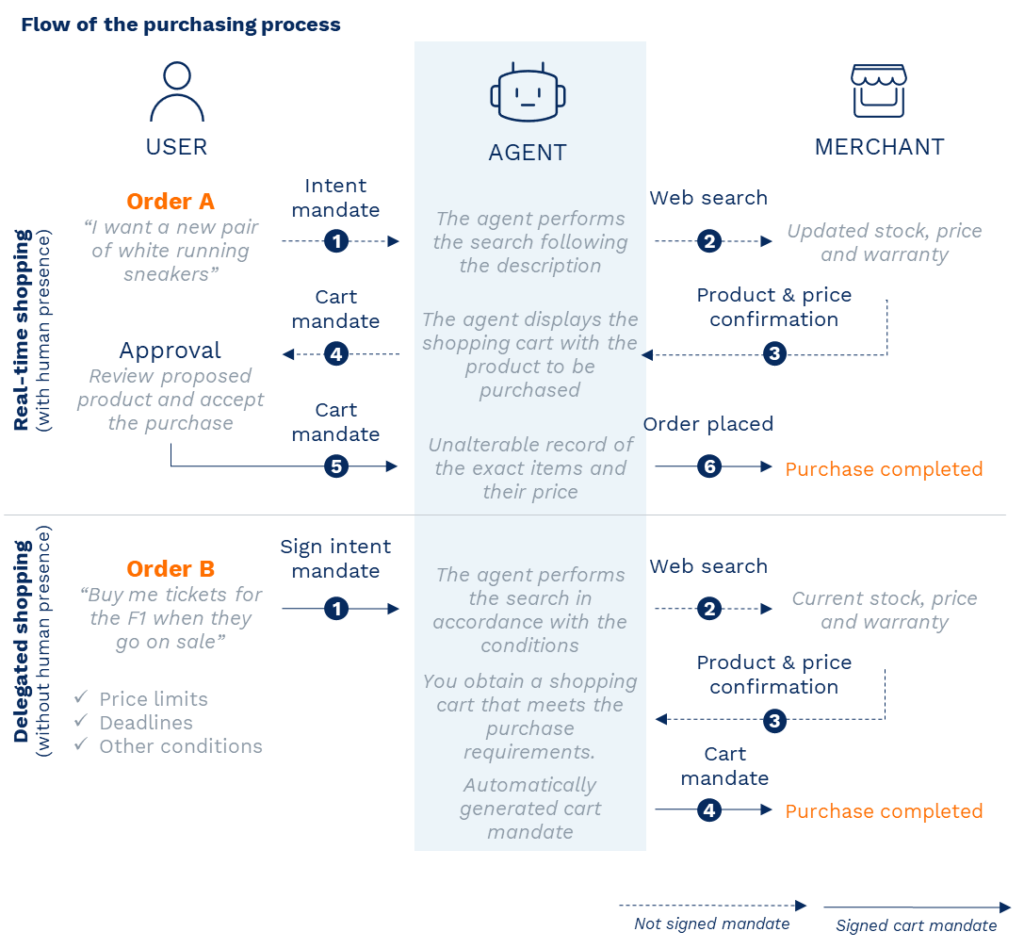
AP2 builds trust through cryptographically signed mandates, which serve as verifiable proof of the user’s instructions for each transaction. These mandates address the two main ways in which a user can make purchases with an agent:
A. Purchase with human presence The user gives the agent an intent mandate (e.g., “find me some new white sneakers”). If the user is happy with the option presented, he signs a cart mandate, which ensures secure registration of the item and its price.
B. Purchase without human presence The user sets an intent mandate with specific conditions, allowing the agent to automatically generate the cart mandate when those conditions are met.

03. Importance of agent-based purchases
In Spain, purchases made by artificial intelligence agents are becoming increasingly important. Although still in their early stages, all indicators point to accelerated growth in the coming months and years, driven by the rapid adoption of AI in areas where it generates real and tangible value.
According to a study by Adyen, in Spain, 35% of users rely on AI to complete their purchases, and 57% find it useful for inspiration when choosing clothing, food, and other items. This represents a 45% increase in AI-assisted purchases compared to 2024, a trend that is expected to continue in the coming years.
At the European level, market projections for AI agents point to a compound annual growth rate (CAGR) of 44.1% between 2025 and 2030, with estimated revenues of €11,488.8 million in 2030.
A recent report by Boston Consulting Group (BCG) points out that agentic AI could influence or directly manage more than half of global e-commerce spending in the near future. This technology is transforming the payment infrastructure, enhancing fraud detection, transaction reconciliation, customer service, and coordination among stakeholders.
The unprecedented speed with which artificial intelligence has been incorporated globally suggests that its impact on agent-assisted commerce will become increasingly significant. This highlights the importance of the launch and implementation of the AP2 protocol, as it ensures security, traceability, and compliance in transactions carried out by agents. Therefore, those businesses or payment platforms that do not adopt AP2 run the risk of losing sales generated by these agents, which could directly affect their competitiveness and relevance in the market.
04. Stakeholders
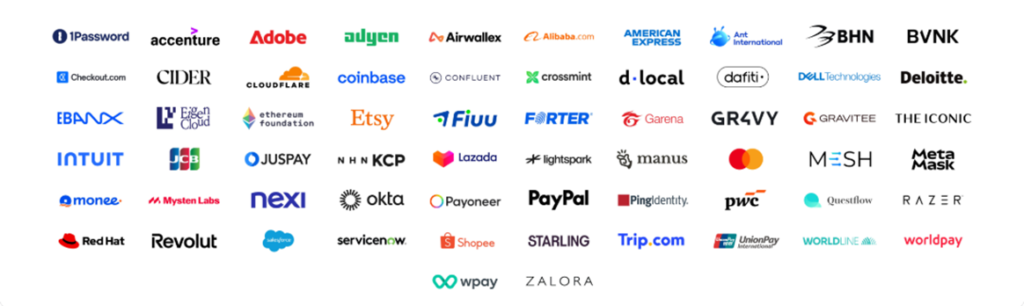
The AP2 protocol is backed by over 60 leading technology and payment companies, including payment providers and networks (such as Mastercard and PayPal), commerce and CRM platforms (Salesforce, Shopify, Etsy), and infrastructure and blockchain companies (Coinbase, MetaMask, Mysten Labs). These players are collaborating to drive the adoption of AP2 as an interoperable ecosystem and establish it as a global standard for transactions carried out by AI agents.
Players involved in AP2
Source: Google in Announcing Agent Payments Protocol (AP2)
Issuing and acquiring banks
Their involvement is key to seamlessly integrating AP2 with the traditional financial system and facilitating payment acceptance
Digital identity and verification providers
Organizations such as FIDO Alliance, Okta, and 1Password could strengthen authentication and identity management in the ecosystem
Other technology and AI players
Companies such as Anthropic, Microsoft, Amazon, and OpenAI would contribute with advanced capabilities for agent integration and secure transaction processing.
Regulators and regulatory bodies
Collaboration with entities such as the European Central Bank would help align the protocol with current financial and privacy regulations

05. Similar initiatives
Although AP2 has been one of the most visible initiatives in the field of AI-assisted payments, it is not the only one. Other players in the technological and financial ecosystem are developing their own protocols to regulate and facilitate AI-initiated transactions. Our vision is that, predictably, these initiatives will enrich each other as they mature, sharing learnings and standards, and that over time they could converge into an interoperable and widely adopted framework that benefits users, agents and merchants alike.
In this context, Near AI is developing the Agent Interaction and Transaction Protocol (AITP), an open protocol that enables AI agents to communicate and transact with each other and with users in a secure, verifiable, and platform-independent manner. Like AP2, AITP seeks to ensure traceability and compliance with user mandates in all transactions performed by AI agents.
On the other hand, OpenAI, in collaboration with Stripe and other leading merchants in the sector, has developed the Agentic Commerce Protocol, focused on providing the framework that enables AI agents and merchants to collaborate effectively in completing a purchase on behalf of a user. Notably, this protocol delegates to the merchant the responsibility of accepting or rejecting each transaction.
Within the ecosystem of AI agent-assisted payments, there are also proprietary solutions such as Visa Intelligent Commerce, Mastercard Agent Pay, and PayPal Agent Payments, designed to execute AI agent payments on the Visa, Mastercard, and PayPal networks, respectively. These platforms are do not compete with AP2, but rather complement it, providing the payment infrastructure and using technologies such as tokenization and authentication to ensure that transactions are secure and reliable, while AP2 defines the authorization, consent and traceability protocols.

06. Opportunities and threats
AP2 opens up multiple opportunities for the various players in the payment ecosystem. It now allows issuing banks to access transactions made by AI agents, as well as offering personalized products based on agent usage patterns and improving traceability and regulatory compliance. On the other hand, thanks to AP2, acquiring banks can attract more merchants that seek to enable agent payments and differentiate themselves by offering integration with AP2. PSPs benefit from an increase in transaction volume by enabling automatic agent payments, the possibility of developing new ones, and greater interoperability with global payment networks. For merchants, AP2 expands the customer base by facilitating access to sales generated by agents and increases efficiency in order capture and payment automation.
However, the adoption of AP2 is not without challenges and threats. Although this technology supports the advance towards “invisible payment,” which improves the user experience, at the same time it reduces the visibility of the payment method, displacing banks from the purchase interface. In this context, banks will need to reaffirm their role as financial control centers, offering flexibility through products such as monthly credit, cards with deferred payment options, or tools that allow for centralized management of automated transactions, thus ensuring their relevance in the emerging digital ecosystem.
In addition, banks will be forced to update their authorization and monitoring systems and face high fraud risks if mandates are not implemented correctly. Payment system players must bear the implementation costs and manage potential reputational risks arising from errors in agent payments.
For PSPs, dependence on correct implementation by other players and greater complexity in security are significant challenges. On the other hand, merchants that do not adopt AP2 risk losing sales to competitors that do implement it and must adapt their checkout and ERP systems. Finally, startups face technical and regulatory barriers to complying with mandates and traceability, as well as dependence on AP2 being widely adopted.
Outside the financial and payments ecosystem, AP2 is particularly strategic for technology companies such as Google and Meta, two of the best-positioned companies in artificial intelligence whose business model depends on advertising. Having information about purchases through their agents, allows them to know not only which products interest users, but also to confirm when the purchase is actually made, thus significantly increasing the value of their advertising investments.
Conclusion
The AP2 represents a turning point in the ecosystem of AI-assisted payments, establishing an open standard that seeks to guarantee security, traceability, and compliance with user mandates in automated transactions. Its adoption not only offers opportunities for growth and differentiation to issuers, acquirers, PSPs, merchants and start-ups, but also defines how agent-assisted commerce will develop in the coming years.
In this context, those businesses and payment platforms that do not implement AP2 run the risk of being left out of a growing volume of transactions generated by AI agents, losing not only direct sales, but also the relevance and strategic data associated with these new flows.
The implementation of standards such as AP2 or others that are imposed on the market thus becomes a competitive imperative: adopting the protocol will ensure that automatic operations are secure, reliable and auditable, ensuring that actors can fully participate in the next generation of digital payments.
In a dynamic and constantly evolving market, where new developments emerge almost daily, Nalba Advisors’ team will continue to closely monitor this and other relevant initiatives, such as the protocol developed by OpenAI and its recent rollout with the launch of instant payment purchases in the US. The goal is to analyze how the market is converging and to anticipate the trends that will shape its evolution.

Authors
The authors of this article are (in alphabetical order), Álvaro Rodríguez, Ana González and María Sancho, consultants at Nalba Advisors, under the coordination and review of Luis Peiró, partner.
Bibliography
Fernández, P. (2025), AI-powered shopping grows by 45% in Spain compared to 2024. https://ipmark.com/las-compras-con-ia-crecen-45-respecto-2024/?utm_source=chatgpt.com
Google. (2025), Announcing agent payments protocol (AP2). https://cloud.google.com/blog/products/ai-machine-learning/announcing-agents-to-payments-ap2-protocol
Martin, R. (2025), Salesforce reveals triple-digit growth in the adoption of AI agents in the retail sector.https://tpvnews.es/actualidad/salesforce-revela-que-crece-a-triple-digito-la-adopcion-de-agentes-de-ia-en-el-sector-del-retail-2025091920739.htm?utm_source=chatgpt.com
Reuters. (2025). Oracle to invest over $1 BLN on AI, cloud computing in Spain. https://www.reuters.com/technology/artificial-intelligence/oracle-invest-over-1-bln-ai-cloud-computing-spain-2024-06-20/
Taylor, S. (2025), Google agent to payment (AP2) explained. https://www.fintechbrainfood.com/p/ap2-explained
Visa. (2025). Enabling ai agents to buy securely and seamlessly. https://corporate.visa.com/en/products/intelligent-commerce.html?utm_source=chatgpt.com
BCG. (2025). The Future is (anything but) stable. https://www.bcg.com/publications/2025/global-payments-transformation-amid-instability
OpenAI (2025). Buy it in ChatGPT: Instant checkout and the Agentic Commerce Protocol. Buy it in ChatGPT: Instant Checkout and the Agentic Commerce Protocol | OpenAI
Legal notice
This article is published for informational purposes only. The information contained herein has been obtained from public sources that the firm believes to be reliable, although its accuracy and completeness cannot be guaranteed. All trademarks, logos and/or registered trademarks are the property of their respective owners and are used for identification purposes only. All images are AI generated and for illustration purposes only.